

Renting a car in Italy is a fantastic way to explore the different regions and get the most out of your trip! For the most part, driving in Italy is easy and the rules are the same as in the US. There are however, a few things to take into consideration before renting a car in Italy. Here are my top tips to help you prepare (and avoid costly mistakes!).


1. You need an International Driving Permit
Renting a car in Italy requires one additional important piece of paperwork: an International Driving Permit. I’ve rented cars in other countries in Europe and didn’t need one, but Italy is one of the countries that requires you to have one before picking up a car. Or, if you ever get pulled over, you’ll need to present this to the officer. Thankfully, obtaining an IDP is simple, quick, and affordable. In the US, you can walk into your local AAA branch. They will take your photo, verify your drivers license, and send you on your way. Less than 15 minutes and $35 later, I walked out with my physical IDP to take on my trip. They are valid for one year and you can postdate it to the first day of your trip to maximize the year. Click here for more info on AAA’s site!


2. Confirm an automatic car, if you need one
An important confirmation to make every step of the way! When reserving a rental car online, the cheapest rates shown will often be manual cars. If you know how to drive manual and are confident, this is a great way to save some money! However since most people in the US drive automatic, you’ll need to filter especially for these cars. Make certain during reservation booking that you’re choosing an automatic car. At the pickup counter, you’ll want to confirm once again that the car assigned to you is an automatic. It’s not uncommon for cars to be switched out at pickup just based on inventory, so make it clear to the agent that you need an automatic car!
3. Gas stations hours
Full disclosure, I rented a car and drove through the Dolomites in Northern Italy and down to Venice. Therefore this may differ in other regions, but I found gas station hours to be very limited. While the pumps themselves are open 24 hours for self-service, the machines confused me so I always made an effort to visit during “open” hours so an attendant could help. With the exception of the large stops along highways, stations in towns would typically be open for a few hours in the morning, close for a while, then reopen for a bit in the afternoon. Typical hours were around 8:00 am – noon, and then 2:30 – 5:00 pm. It was a little hard to plan my fill ups when I was our hiking for most of the days. Definitely check the hours of the stations along your route ahead of time!
4. Paying for gas
While paying for gas may sound like the simplest thing ever, it actually was a little complicated at times. It was 50/50 on whether stations I visited would accept American credit cards. Some did with no problem, but others would decline the transaction (even when I tried every card in my wallet- didn’t matter if it was Visa, Mastercard, etc.). I’d recommend having extra Euros on hand just for this expense if it comes up! Gas was more expensive than what I pay for a fill up at home, but nothing mind-blowing insane. My rental Volkswagen SUV cost about €70 to fill up completely.
5. Diesel gas
This one actually threw me for a bit of a loop when renting a car in Italy! Upon pick up, the attendant at the Hertz counter advised me that the car ran on diesel gas, and to be very careful to use the correct nozzle when filling up. This shook me. Diesel, for a regular ol’ SUV? Turns out, that’s the norm with newer cars. The man at the counter next to me rents cars in Italy frequently and said that for the last few years, this is very common with newer vehicles. Make sure you confirm which type of fuel your car uses before you leave the rental car lot!


6. Highway tolls
For some reason, I struggled at the tolls in Italy! And from my conversations with other tourists I met along my travels, I wasn’t alone. When entering a tolled highway, you’ll receive a ticket. The city that you’re entering the highway on is listed in the upper left (in the photo above, it’s Belluno). When it’s time to pay the toll, you’ll get in a line to pay electronically. Pay careful attention to the different lanes- there are some that only accept EU credit cards, so you’ll want to get in the lines that display a generic cash or credit (not the ones that have the EU flag!).
If you struggle at the payment machines like me (for some reason none of my tickets could be read?), there is a help button you can press to talk to a live agent. In my experience, they all spoke English. They’ll ask you which station you entered the highway at, which is when you’ll tell them the name on the upper left of the ticket. They can then manually enter the amount due and you can pay with cash or card. It’s embarrassing to have a line of cars waiting for you while you iron that out, but it is what it is!


7. Crossing country borders
If you plan on using your car to cross country borders, it’s usually not an issue but it’s always a good idea to disclose this to the rental car company at pickup. They’ll try to upsell you on different insurances for the countries and you can make your own decision on whether to accept or decline those. If you’re traveling to another country by car though, check if that country requires a vignette! This was my first experience with these, but they appear to be very common in certain European countries. I traveled to Slovenia on this trip and both Slovenia and Austria (close neighboring countries) require vignettes to drive on their roads.
The process is simple, but important. As soon as you cross the border, stop at the first gas station or convenience store (you’ll likely see advertisements for vignette sales). Vignettes are all electronic these days, so you’ll give your license plate number and purchase the vignette for a certain amount of time. Then, you’re good to go! It’s a good idea to save the receipt in your car to be safe, but definitely don’t skip out on this. If you’re caught on roads without a vignette, it can be up to a €300 fine per occurrence. The checks are all electronic, so it’s not worth risking!
8. Watch for ZTL Zones
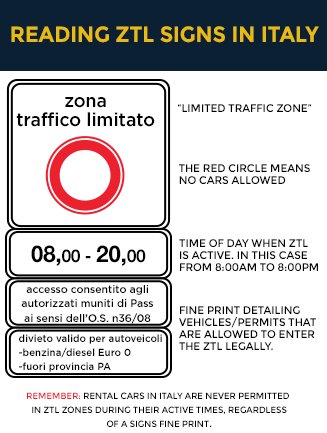
ZTL Zones (which stands for Zona a Traffico Limitato) are basically streets that you cannot drive on during a certain time period. You’ll find these typically in the larger cities, often in the central areas. It’s meant to help cut down on traffic and make the streets more pedestrian-friendly. If you’re planning on visiting larger cities with a rental car, pay very (very) close attention for these signs and do not enter these zones during the posted hours. The fines can be steep and it will be per occurrence. Whiel you may not notice at the time, you’ll receive a hefty bill months after your trip if caught. Here is a helpful resource for spotting and understanding the signs.
If for some reason you do need to enter a ZTL during the hours posted (like for example, if your hotel is located in a ZTL), you will need to register your license plate ahead of time. When picking up your rental car, speak with the agent. They can often either do it for you or point you in the right direction. You may need sign off from your hotel confirming your stay to register your license plate. It can be a bit of a process, but very worth the work to avoid steep fines!
Traveling soon? Check out my Travel Tips page to help you score good deals on flights, packing tips, tools to help you plan, and more!








No Comments